
Committed to join forces, advance, protect, preserve and enhance the mutual interests, treaty rights, sovereignty and cultural way of life of the sovereign tribes of Michigan throughout the next seven generations.
- HOME PAGE
- CONTACT US
- UNITED TRIBES SCHEDULES
- PAST ARTICLES
- TRIBAL LINKS
(to tribal web sites and other sites of interest) -

Subscribe to our RSS Feed
Great Lakes Water Compact:
June 4th, 2008
Update, by Meghan Kelly Powell, Federal Liaison, Ogitchiida Qwe, Inc.
The Great Lakes Water Compact, originally proposed by the Council of Great Lakes Governments, was approved by the Michigan and Wisconsin State Legislatures last week. The Compact includes conservation measures and water use restrictions, designed to protect the Lakes against "diversion and over use." Other states that have approved the Compact are Indiana, Illinois, Minnesota, and New York. The Canadian Provinces bordering the Great Lakes (Ontario and Quebec) have already approved similar and compatible measures.
For the measure to have the force of law, the Compact will need the approval of two additional states (Ohio and Pennsylvania), and then the approval of the U.S. legislature. Despite expected clashes regarding a private property rights amendment, the Ohio State Senate President is hopeful that the Compact will pass before the June recess. As for Pennsylvania, the State House approved the Compact in January, and the State Senate Environment Committee will vote on the issue in June.
Federal approval of the Great Lakes Water Compact is likely if it reaches the U.S. House of Representatives prior to 2010. Currently, Representatives from the Great Lakes states have the necessary numbers to pass the Compact if it comes before them. However, they may not be able to maintain this power if the Great Lakes states experience the loss of any additional seats in the House of Representatives (The 2000 Census reported dwindling population levels in Great Lakes states, resulting in the loss of nine seats within the House. It is expected that the 2010 Census will reflect further population losses within the Great Lakes states, resulting in the loss of additional seats. Sunbelt States, traditionally water-poor, are likely to gain seats).
Why is this important to the Tribes?
The Compact bans water diversions outside the Great Lakes basin (i.e. the "Soup Bowl and Soup Bowl rim") with very limited exceptions. Without the federal approval of the Compact, Great Lakes states may be required to divert water resources to states with very little water resources (such as states within the southwest United States). The impact upon fishing, farming, shipping, tourism, the environment, and Tribal culture would likely be significant.
Tribes must remain vigilant on the issues surrounding the Great Lakes Water Compact. It will be important for the Compact to get through the House and Senate quickly. Tribes need to maintain a good foundation for its passage on the federal level. If you have any questions, or need additional information, please contact Meghan Kelly Powell at federalliaison@yahoo.com or by phone at (757) 777-8838. Meghan is a member of the Sault Saint Marie Tribe.
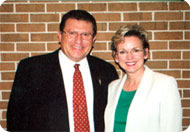
United Tribe's now Executive Director Matt Wesaw is shown above meeting with Michigan Governor Jennifer Granholm at a United Tribes Summit held during the summer of 2006. Governor Granholm spoke to those attending the summit, congratulating them on the formation of the United Tribes of Michigan association. Granholm was re-elected to her gubernatorial position the following November to another full term.