
Committed to join forces, advance, protect, preserve and enhance the mutual interests, treaty rights, sovereignty and cultural way of life of the sovereign tribes of Michigan throughout the next seven generations.
- HOME PAGE
- CONTACT US
- UNITED TRIBES SCHEDULES
- PAST ARTICLES
- TRIBAL LINKS
(to tribal web sites and other sites of interest) -

Subscribe to our RSS Feed
University of Michigan Repatriation
The Detroit News' Mike Wilkinson writes "On the wooden shelves of a University of Michigan laboratory, thousands of relics -- ceramic bowls, copper beads and stone and bone tools -- await the careful eyes of researchers". Read the remainder of the Detroit News article here
Group Looking at California Worries About MCRI Effect
A study of the impact of a California proposal that outlawed affirmative action indicates that programs, especially education programs to help both women and minorities, could be hurt dramatically in Michigan if the Michigan Civil Rights Initiative is passed, the Center for Education of Women at the University of Michigan argued.
The center issued the report after studying what it said were the effects of Proposition 209 in California, the first state to adopt a proposal explicating banning the use of affirmative action on the basis of race and gender in hiring and education decisions. The report, written by Susan Kaufmann, associate director of the center, said if the MCRI is approved and becomes part of the constitution, it could have a major effect on programs designed to improve access to education and employment as well as on admission and hiring decisions.
Jennifer Gratz, executive director with the MCRI, acknowledged there would be effects if the proposal passes, because it would make programs based on race illegal.
"People will have to rely on their character and merit to gain admission and not race," she said. But she also said the report seems to belie claims made by supporters of affirmative action that race is only one factor in admissions and hiring decisions.
"This seems to say that race is a super factor," she said.
The California proposal, similar in many respects to the MCRI, has been in place for nine years. After it was adopted, a large number of statutes had to be either amended to eliminate reference to race or gender, or have their basis for program selection changed to socioeconomic status, the report said. In addition, court decisions in that state held that Proposition 209 outlawed state efforts even to have greater outreach to minority and female-owned businesses, the report said.
Court cases have also been filed against voluntary efforts to consider race and gender in education and hiring and contracting programs. The report said that while the numbers of minorities have become a larger percentage of high school graduates in California, they are a smaller percentage of incoming freshmen in the University of California system.
However, the report did indicate that part of the decline in freshmen admissions could be accounted for because a larger number of minority and women have been enrolled in private colleges in the state. Based on that finding, the report issued concerns that should the MCRI pass in Michigan fewer minorities, in particular, would be admitted to Michigan universities.
What could be particularly affected, the report said, are programs designed to help minorities and women prepare for college. But Ms. Gratz said that affirmative action supporters continue to forget that when the US Supreme Court issued its decisions on affirmative action at the University of Michigan it said that eventually affirmative action programs would have to end.
"The University of Michigan seems to think these programs can go on forever," she said.
Click here to open the research report on the Potential Impact of the Michigan Civil Rights Initiative on Employment, Education and Contracting. Since this is a larger Adobe Reader® PDF document, if you have a slower connection just right click here and select "save as", "save link as" or "save target as" (different menu choices appear depending on the type of Web browser you are using) and you can directly download the PDF to your computer.
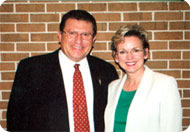
United Tribe's now Executive Director Matt Wesaw is shown above meeting with Michigan Governor Jennifer Granholm at a United Tribes Summit held during the summer of 2006. Governor Granholm spoke to those attending the summit, congratulating them on the formation of the United Tribes of Michigan association. Granholm was re-elected to her gubernatorial position the following November to another full term.